4. Where do the thoughts come from?
The question is: Where does the thought originate or who "makes" it? I also pursued this question on the basis of absolute information, because I didn't want to be guided by my subjective point of view.
The human being is an absolute structure that can be used to learn many things. Just as a computer, for example, is made up of many components, the body consists of many interconnected organs. They function in a complex interplay. Somewhere, all the organs of the body must be controlled and regulated. So there must be a center that connects them all. We know that the cerebral cortex forms this center, the connection point for the entire body. In our cerebral cortex we have the entire body represented. This is where all the "wires" connect in the form of nerve pathways that control the body.
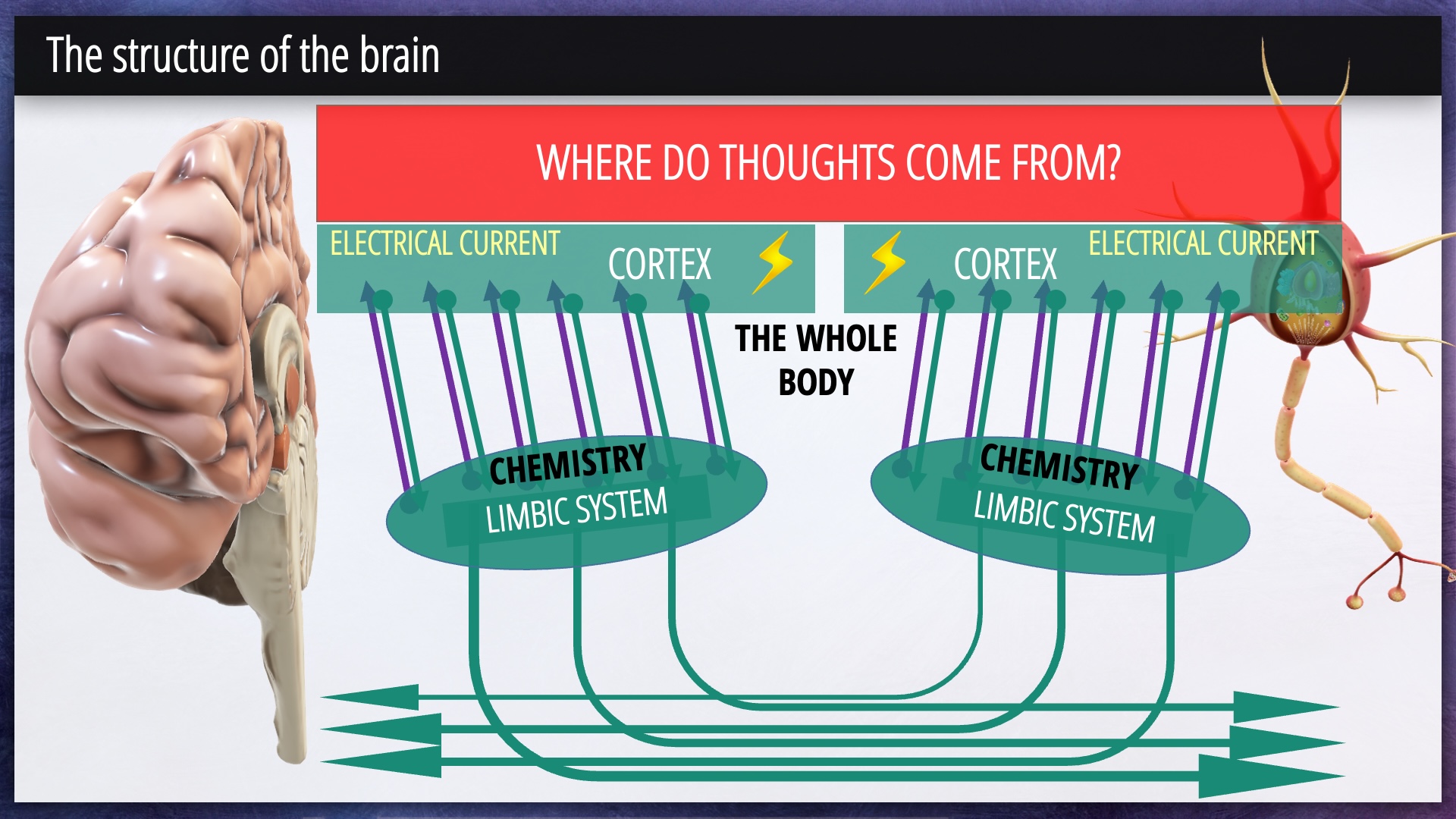
We will therefore take a closer look at the structure of the brain. The cerebrum consists of two hemispheres (or halves) of the brain. The cerebral cortices of these two hemispheres are not connected to each other, so an incision could be made in the middle without cutting the cerebral cortex. Although underlying structures in the brain would be destroyed, the cerebral cortex would remain whole. This is an important point for the question as to why we have one-sided physical illnesses.1
The outer cortex is a corrugated layer only 4 to 5 mm thick. It consists of billions of nerve cells, also known as neurons. These function as conductive cables that extend from the cerebral cortex into the body. In this way, the entire body is combined in the cerebral cortex. Everything that happens in the body begins in the cerebral cortex. From there, the nerve tracts lead to the center of the brain, the so-called limbic system. They then divide, change sides from right to left and vice versa and then run throughout the entire body.
Every physical function begins with an electrical impulse in the cerebral cortex, which triggers all further steps in the body. Incidentally, each of the nerve pathways are isolated. Only in this way can the current reach the right place in the body and, for example, move the little finger precisely. This electrical impulse reaches the limbic system. There, the impulse leads to an initial chemical reaction, which is immediately reported back to the cerebral cortex, the emotion reporting whether I am happy or not. This signal is the first feedback as to whether the electrical impulse or current is appropriate for the body.
Where do thoughts originate? Do they originate in the brain, for example in the cerebral cortex, or rather in the limbic system? Or do they come from outside the brain? The Basic Law of Nature again helps us to find the answer.
Conventional medicine claims (in simplified terms) that thoughts arise between the synapses of nerve cells in the cerebral cortex.2 Brain waves and chemistry would interact and in the course of such a process, for example, an idea would arise. But there are billions of nerve cells. Which of them has the function of controlling thoughts? Which one makes the final decision? There must be a superordinate point somewhere, at least a kind of starting point similar to a technical machine.
Hence the question: Can the brain think for itself? To answer this question with certainty, we need to look at what the brain is made of. Just like all known matter, it is made up of atoms. The atoms of the different elements of the periodic table can react with each other. We know a lot about the processes of the chemical reactions that then take place.
These chemical reactions:
- can only occur depending on external factors
- cannot take place by chance, because the preconditions and possible outcomes for a reaction are always predetermined
- can absorb, store and pass on energy and information
Chemical reactions are defined in the laws of nature at an atomic level; they always take place in the same way. This is the only way to produce cement, for example, that meets certain standards. We know we can use electronic devices because chemistry absorbs information and stores it in a retrievable form. Chemistry can also absorb and transfer heat.
At the same time, we know what is naturally impossible with chemical elements. Computers have no thoughts. They cannot think, even if they have facial recognition software or so-called "artificial intelligence" and can react. "Reacting" does not mean "thinking".
Chemical elements:
- cannot feel anything (a cell phone feels nothing)
- cannot choose, i.e. cannot make decisions
- cannot control or destroy themselves
- cannot have morals
- cannot have consciousness (how much consciousness does a computer have?)
- cannot self-reflect
Chemical elements are therefore certainly not the source of thoughts. But where do thoughts come from? Why can humans think? If the brain is composed exclusively of chemistry, then it is naturally impossible for it to think independently.
Humans can feel and think. However, chemical elements are numb. The nerve in the injured finger transmits an impulse to the brain. Only then does a feeling arise in the head. Who feels the pain? Where is the seat of feelings? The existence of feelings is in itself proof that human beings cannot be made up of chemistry alone.
Furthermore, humans can destroy themselves, unlike non-living elements in nature. The laws of nature do not provide for the self-destruction of matter. However, people can jump to their death from an 11th floor window in response to information that does not meet their needs. This is what the boyfriend of one of my patients did. When she broke up with him by phone, he jumped to his death during the call.
Something made of chemical elements, e.g. a computer, cannot bring about its own demise. However, there are observations of self-destruction in animals. For example, when a beloved owner dies, cats or dogs often become seriously ill and perhaps die. Some animals even refuse to eat until they die. Why do they behave like this?
So there must be something in humans and also in animals that first gives rise to the idea of self-destruction before such a decision is made.
People have cognitive abilities; they can be happy or angry with other people. This means that they can consciously perceive information and react to it in a recognizable way. People can also make choices. They choose their life partner, their profession or even a car. Matter cannot do any of this.
Where do people get all these abilities from? Where is the source? Is it in the brain? The Basic Law of Nature rules out the possibility that chemistry alone or an organ consisting exclusively of chemistry can think. What remains to be clarified is what is it in humans that can think? Only then can we answer the question as to where thoughts come from.
-
According to the laws of inheritance, the two cerebral cortices are each particularly characterized by one parent. ↩
-
An overview is provided by Eccles, J. C. (2000): How the self controls its brain. (3rd ed.) Piper. His statement of the limitations of materialistic solutions is remarkable, see p. 261f. ↩