11. Creator or Creature - The True Identity of Man
All of my patients' demands on their parents, partners, children, siblings, friends, etc. point to an elevation of one individual above another. This means that all demands arise from the assumption that the other person owes it to me to fulfill my needs. This automatically makes them my subordinate, who must be available to satisfy my needs. On the basis of the well-known human motivations - selfishness and pride - I have seen where this claim to superiority comes from.
Behind selfishness is the conviction that "I have property". This means that something belongs to me personally. Pride arises from the attitude "I can create". This means that I can create something from within myself and pass it on. With this attitude, people always give first and want to get something in return. Even if they consciously think that they are doing it without wanting to receive anything in return, this manifests itself as self-deception. For example, people become angry when they are not given a simple "thank you".
Because everything revolves around personal loss and this thought destroys a person's body, I asked myself whether a person can really have personal property. I have spoken to many people about their worst experiences. Some had lost a child or their child had been abused. Although many years have passed since the event, the parents are still burdened and hurt and the physical illnesses have increased in intensity.
Previously, we have described the body as a mirror to aid self-knowledge. Anything that destroys the body, i.e. makes it ill, cannot be right. This also applies on a spiritual level, even if the spirit believes it to be right. Thus, personal loss must be regarded as a wrong principle, precisely because it destroys the body and imprisons the spirit. So where does this serious, all-destroying error of thought come from?
The spirit must evaluate every event. If it now evaluates a child as its property and the child dies, possibly through an unnatural event, then the spirit destroys the body with the thoughts of this irrevocable and great personal loss, because it does not have the ability to accept a personal loss. It cannot lose. The human being simply does not have the ability to say yes to personal loss.
The question therefore arises, is the claim to own something justified? Why can man, even if he thinks otherwise, have no property? The answer is simple: because he cannot create anything. Only if he could create something would it really be his property. But since everything, including man, functions as a channel, he cannot create anything. He can make things happen. He has the ability to assemble things, to take them apart, to put something beautiful together with his imagination, to paint, etc. However, this is not the same as creating something, because every result of human effort comes from what is already there and what already exists is only used. The child also comes through the parents, but not from the parents. In his error, however, man thinks that he can create things, even life, and that the child comes from him.
Thus the illness of the body, together with the imprisoned spirit, proves that man is mistaken when he thinks that something belongs to him. The Basic Law of Nature also proves that nothing belongs to itself. Man's claim that he belongs to himself, that his body and life belong to him personally, comes from a self-deception that we must uncover.
The second idea from the false motivation of the spirit says that it can produce something of its own accord. Which of his needs does man think he can actually produce himself? Let's take another look at the basic human needs. Oxygen clearly shows our dependence on the environment. According to the principle of taking in order to give, humans have to get the oxygen they need from the air. The same applies to water. Without a source of water, people die very soon. Humans cannot produce food, but can only prepare it if they have first taken it from nature.
The basic need for love cannot be denied. Everything in human life revolves around love. That is why it is important to ask where love comes from. We should be clear about this: If love is a need of the spirit, it can only be a matter of information. Spiritual needs such as love, justice, freedom and security are spiritual information. They are not energy in the sense of an electromagnetic wave. They are purely spiritual information expressed in words or images. They are not measurable or perceptible energy. Only when they are processed by the spirit are they translated by the spirit's decisions at the cerebral cortex into specific electrical impulses (energy) that can be physically measured in and on the body.
Can people produce love, i.e. the spiritual information they urgently need, for themselves? Are they producers of information or users of it? On the physical level, we have no doubt that resources are only used, not created. On the spiritual level, we must also realize this: we convert information in the spirit, just as the body converts chemistry. We can observe that media has only been able to develop so strongly because the spirit is insatiably crying out for information. From a very early age, a child sits fascinated in front of a screen and absorbs the information. If parents today want to keep their children quiet, they can do this very well with a cellphone or another screen. Children can even go without food for a surprisingly long time whilst absorbed in screen time.
Due to the error residing in the spirit, people think that they can actually generate information, including love. Almost all my patients say yes to the question of whether they can produce love themselves. If that were the case, then love would not be a basic need. Everyone would have their own source within themselves where they can produce love and live from it. However, the fact that everyone seeks love and above all wants to be loved by someone else shows that they do not have love within themselves. According to the law, love must first be absorbed, processed and passed on. In a channel there is only flow, but no production of basic elements. A channel only ever passes on something that it has previously absorbed and processed. Humans cannot create anything new. We have to understand that even when we build houses and airplanes, we are not creating anything new, but rather assembling things from existing materials. Our spirits are equipped with many extraordinary abilities, but it is not possible for us to create even a single basic element from nothing.
Man's false conviction that he can possess or even create something must come from a source. This starting point is his identity. "Who am I?" is what the mind uses to process all information.
There are only two identities that are fundamentally possible in our world. Either man is a creator (i.e. a source) and therefore God, or he is a creature (i.e. a channel). So, who does the human spirit believe it is? Either it believes "I am a creator" (i.e. "I am God") or it believes "I am a creature".
A creator is a system that exists in itself. He has no needs, because He is the origin. He is the cause of everything and therefore the origin, because an origin has no cause, otherwise it would also be an effect. This origin is self-contained and requires no absorption i.e. a creator has no needs. He feeds and supplies everything in His creation of His own accord.
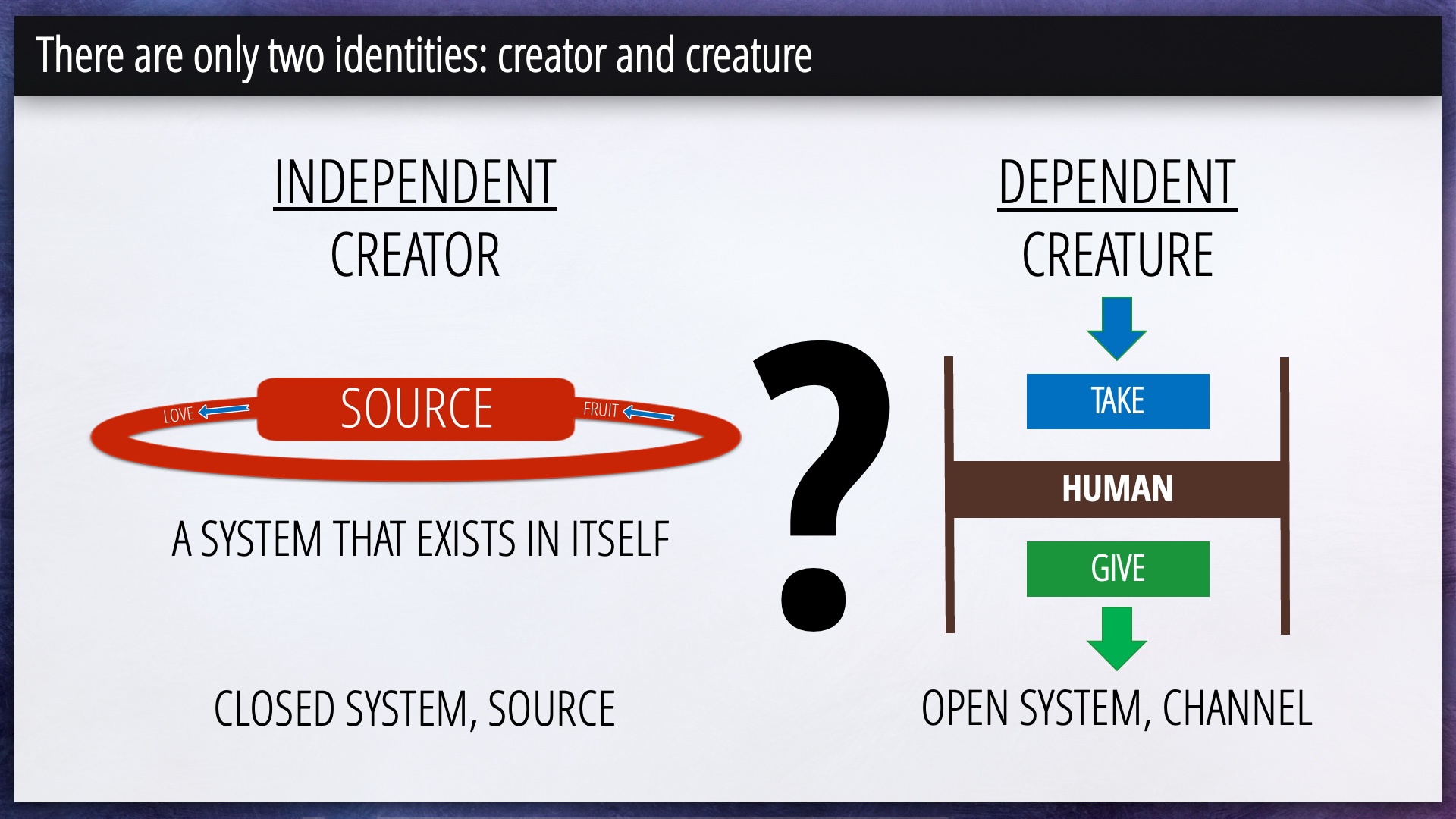
In contrast, a creature is, by definition, always structured as a channel. It must always first take in order to give. This means that every creature, without exception, must be structured as an open system and be absolutely dependent. So, in which category do humans fall? There is no doubt that humans function as a channel and are creatures. On the physical level, this is quickly acceptable to everyone, but on the spiritual level, man does not see his error.
The human spirit, in its error, thinks that it is "God". However, every patient I talk to about this immediately says: "Doctor, I've never thought like that before!" This may even be true for conscious thinking. But I had to realize that I have only "Gods" as patients in my practice. It is always the patient's demands on his fellow human beings that leads him to distress and, as a result, to illness. Without these demands, the spirit would be free and therefore the body would also be free of illness.
As a doctor, I am faced with the challenge of proving to the patient that he inwardly thinks he is "God", even if this happens only unconsciously or is not realized. All problems people have arise from the fact that they elevate themselves above others.
There is clear evidence that man thinks, "I am God". Man's inner attitude can be seen in his behavior. There is the exercise of power over others. Even in the womb, a child begins to exercise power over others, and the next power struggle begins at birth. Who is stronger, mother or child? The exercise of power stems from the idea that one is a higher being than the other. If I am on the same level as the other person, I wouldn't think of striving for power. If the other person does not bring me any gain or cannot reduce my loss, then I do not need to exercise power over them.
You may have heard of the famous experiment in which some college students were assigned to be inmates of a prison and others as guards. In a short time, normal people began to behave inhumanely. After a few days, the experiment had to be stopped prematurely because the guards began to torture and torment the inmates for no reason at all.1 Everyone who is given power changes their behavior, abuses the power sooner or later and no longer wants to give it up. Only when someone manages to free themselves from the misconception of false identity will they be able to handle power properly when given authority.
Exercising control over others reveals your inner attitude. Nobody likes to be controlled by others. Nevertheless, many people strive for control over others in very different ways. For example, one person installs a camera in his wife's car so that he is sure she is not cheating. Others control their partner's or child's cellphone. Of course, everyone wants the good, but the good for themselves.
People also set themselves up as judges and like to pass judgment on the behavior of others. Who is the yardstick for their judgment? Only themselves, of course.
People demand different forms of worship. They believe they are entitled to praise, thanks, respect or recognition from others. That is why they expect and demand it.
To illustrate, I had a patient who had organized a big party in a restaurant. When he went home and looked through the bill he had already paid, he realized that he had been undercharged by a considerable amount, €200. Wanting to be honest, he brought that amount of money to the manager the next day. While my patient was with the manager, he and his wife drank a glass of juice. He assumed that he didn't have to pay for the juice as he had voluntarily paid the shortfall of €200. But when the manager demanded €5.80 for the juice, the patient reacted angrily and didn't go back to this restaurant for the next 15 years. So why had my patient paid the extra money? Did he do it "for nothing"? Why did he want a reward for his good deed? If he wasn't "God", the manager wouldn't owe him anything for his honesty, would he?
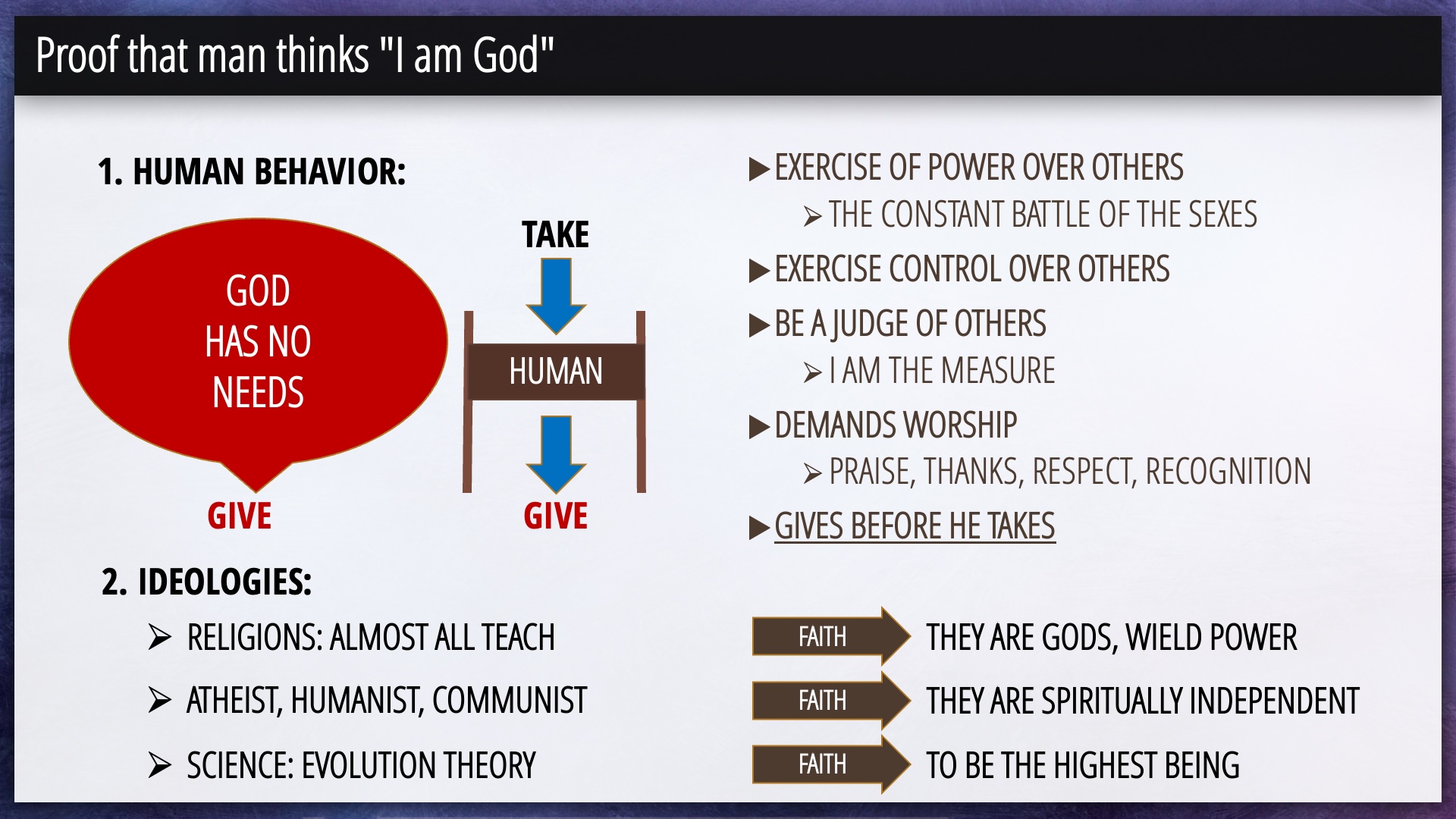
The clearest proof that man thinks he is "God" lies in the fact that he supposedly gives before he takes. "God" has no needs, He only gives. Man is a channel; he must always take before he gives. If it happens the other way around, then he must supposedly be "God", otherwise he would not act in this way.
There is another approach that reveals our dangerous fundamental error. It can be seen in the various ideologies written in so many books. One example is religion. All mainstream religions teach a belief in which people exercise power or coercion, which then turns them into "Gods". Any system that exerts coercion on people2 and dictates what they must or must not do is based on this fallacy.
There are also the worldviews of atheists, humanists and communists. All of these philosophies have one major thing in common: the belief that humans are spiritually independent. As a consequence, this means that people produce their own love and satisfy their own spiritual needs. Their error is revealed in times of need, such as, when these people collapse because their wife or child dies. This shows that they are anything but spiritually independent. Their ideology stems from the perspective of "I am God", but if they were "God", they would have to be spiritually independent.
Much of science is also based on a profound error, namely the theory of evolution. It forms the basis for the belief of science that a higher being can emerge from a lower being, as long as there is enough time and ingredients for this to happen. Man, as the highest being in this system of thought, is then inevitably "God".
Without going into details, there is a common false root for all ideologies (religions or worldviews). Ultimately, they are all just branches and twigs on a single tree. The root is the inner conviction of man "I am God". People behave in exactly the same way, each one considering himself better, more skillful or smarter than the other. Everyone is in competition with each other. People judge each other. They want to control and suppress others, even to the point of violence, war and murder.
The situation is no better within religions, including Christianity. Everyone thinks of himself as "God" and behaves accordingly. He sees himself as higher than his neighbor. The consequences are just as bad as for non-religious people. Many wars have been fought over purely religious issues.
The previously mentioned behaviors and ideologies of man prove that he considers himself to be more than just a creature. If he believed the truth about himself, which reason and visible facts cannot deny, then there would be no arrogance, competition, measurement of strength, coercion and violence.
The only solution to the basic human problem is to recognize the right identity. This would always lead to unity and peace. If man thinks: "I am a creature", then there is room and space for everyone. Different nationalities, skin color, different sizes, clothes, tastes, abilities and different tasks would not cause tension, comparison or conflict. Everyone would see themselves on an equal footing with their neighbor. No one would claim to know better or be able to do better. We would not be in constant competition with each other. Only "Gods" have to measure and compare themselves with each other. There would be no power struggles between creatures, no one would have to judge the other. There would also be no need for control. There would be no violence, murder or war. The solution to all problems is therefore to understand correctly: "who am I?" really.
If I live in the identity: "I am a creature", then I comply with the law. As a creature, I know that I cannot produce anything and have no property. Before I give, I must first take something. This applies to physical needs as well as to love (as the sum of spiritual needs). If I don't keep anything for myself but pass it on, I always have profit (gain), because my profit lies in giving. Whenever we have loving thoughts towards our fellow human beings, we are fulfilled and feel good!
That is why self-knowledge is so important. We all deceive ourselves because of an innate lie about ourselves. This lie consists of a false identity. We believe we are someone we are not and can never be. This begins at conception and continues until death. The origin of all negative things is self-deception and the elevation of one above the other. It is true that we cannot help being born with this lie. However, as soon as we see and recognize this error, we should look for a solution to get rid of it. If we keep it, this error will inevitably destroy us.
The problem of man therefore lies within him, not outside of him. That is why we cannot find a solution outside of ourselves. Laws, state and church rules cannot solve the problem. Every person is their own individual and can therefore only solve their problem within themselves. However, the difficulty lies in people recognizing that they have an inner problem. As long as people are mistaken and always look for the problem outside of themselves, they will never really find a solution.
-
Banks, C. W., Haney, C., Jaffe, D., Zimbardo, P. (1971): The Stanford Prison Experiment: A Simulation Study of the Psychology of Imprisonment. Conducted August 1971 at Stanford University. ↩
-
In contrast, a consequence is not to be equated with coercion, because it does not force people to change, but only shows them their limits and the consequences of their behavior. ↩