12. Who Bears the Loss?
The thought of having suffered a personal loss can shape the rest of your life. I would like to describe this in some very difficult cases.
Case 9
While abroad, I met a young woman in her early 20s who had been suffering from depression for five years and had repeated suicidal thoughts. Generally, suicidal thoughts stem from the false identity "I am God". What had happened? Five years earlier, when she was a teenager, a friend from kindergarten days contacted her. He invited her to go to a cafe in the city. He had even asked her parents if he could take her with him. The man picked her up in his car. However, there were three other men in the car. They stopped on the way, raped the girl and almost killed her. In mortal fear, she somehow managed to escape and asked for help in the next village. The man who supposedly wanted to help her took her into his car only to rape her again and beat her almost to death.
This young woman had lived through two terrible events in quick succession. Is what the men did to her wrong? 100%. But what is the reason she is suffering so much psychologically after five years? Is it still the event or is it the processing of it?
Is it the trauma that we can't help that makes life difficult for us? Or is it what we think about the trauma? Surprisingly, many rape victims have a way of thinking that is incomprehensible from the outside. The young woman felt remorse that these bad things had happened to her. "You didn't get into the car to be raped", I interjected. But the woman disagreed, "No, I could have prevented it!" Her remorse, the thought that she could have prevented it, comes from the idea: "I am God" or "I know in advance what can happen". But no one knows what will happen in the future. However, the woman was firmly convinced that she had done something wrong and had therefore been raped.
This case shows the terrible erroneous thought process of human beings. It is difficult to show patients their error when they are deeply convinced that they are right. Nevertheless, there are fortunately good arguments for revealing the error. Then I asked the woman, "What does the thought of blaming yourself do to you?" She answered, "The thought doesn't do me any good."
At this point, the woman was certainly right. Please check for yourself how you feel when you have thoughts of guilt. The body reacts immediately and sends a clear signal: this is an unfree and untrue thought. This was the first piece of evidence that the woman was processing the event incorrectly. The second proof was her depression, the confusion of her bodily processes. Her suffering proved that her assessment, i.e. her thoughts, were wrong and could not be true.
The person concerned is not responsible for the crime. However, they should do everything in their power to avoid using this act against themselves and destroying themselves as a result. To do this, they must have a solution to their problem.
Case 10
An elderly patient had had a bad cough for almost two years. The cough would not go away, neither by inhalation nor with medication. I could already hear the cough from the waiting room. In addition, she had been suffering from abdominal cancer for 20 years, which had led to an incontinent bladder for 10 years. The patient had to empty her bladder every 30 minutes. The combination of coughing and incontinence was very stressful for her and could not be resolved even after several operations.
The patient's story was as follows: Her mother had never praised her. During her childhood and adolescence, her mother had only taken advantage of her and preferred her brothers. Her mother had died 20 years ago. It was therefore no longer possible for the patient to compensate for this deficiency in any way. Now, even at almost 80 years of age, she was still suffering greatly from the fact that her mother had not praised her. She effectively had her mother on a list of debtors.
What would it take for this elderly patient to get better? She would have to recognize the error in thinking her mother owed her praise. At first glance this sounds very harsh, but she would have to be more than a child, namely "God", if her mother had to praise her. During the counseling session on the functions of man and the law of nature, I explained to her, "In order to become healthy, it is necessary to love your mother and thus release her from guilt. The thought that your mother has only taken advantage of you is stressful and your body clearly proves it."
Because the patient was a woman of faith, I advised her to ask God to help her change her view of her mother so that she could love her. After three weeks, the patient came back to the office. Although she sat longer than usual in the waiting room, I didn't hear any coughing. When she came into the treatment room beaming with joy, she declared, "I haven't coughed since I last saw you and my bladder is working perfectly again." She had expressed this desire for love for her mother to God during her evening prayer and as a result she had recovered.
Our spirit is responsible for what happens in our body. The spirit causes a problem in the body because it thinks that others owe it something that it absolutely needs.
Case 11
A female patient, around 60 years old, had advanced cancer.
At the age of three, she was disowned by her mother and given away. At the age of 13, she was raped by her friend's brother. Later, without knowing it, she married a man who was a pedophile and abused their children. When she found out about this, she divorced him, but the damage inflicted remained in her mind as a personal loss. Eight years after the divorce she became ill.
Her life story was anything but pleasant. Let's put ourselves in this woman's shoes. She has been wronged many times over, starting in her early childhood. Can those who wronged her make up for their offences? No, the injustice she experienced cannot be made up for. However, her sense of justice demands it. She cannot turn off her desire for justice. Thus, she destroys herself through her inability to satisfy her sense of justice.
No matter what the content of a thought may be, all thoughts arise from either the truth or a lie about oneself. There is nothing in between, not even a neutral area. It is always just the one lie about ourselves that is the real problem. Since all of this takes place in the subconscious in a rapid sequence, we have to consciously question our way of thinking about events involving loss.
We therefore want to look at the fundamental differences between the two identities "I am God" and "I am a creature".
Dependence
If I am "God", I am spiritually independent, because I am the producer of the information I need.
If I am a creature, then my spirit is a channel, and I am automatically spiritually dependent on my Creator.
Ownership
If I am "God", everything belongs to me.
If I am a creature, nothing can belong to me.
Autonomy
If I am a "God", I do everything from and out of myself.
If I am a creature I can do nothing from myself. I give only what I took before.
Point of reference
If I am "God", everything revolves around me.
If I am a creature, nothing revolves around me.
At the end of the thought process, there is only the classification of gain or loss. However, a personal loss is not acceptable. Therefore, the question remains to be answered: Does personal loss really exist or is it an illusion? Based on the destructive effect on the body of the person who has the thought of loss, the hopelessness of the spirit and the Basic Law of Nature, the idea of personal loss must be uncovered and understood as a delusion.
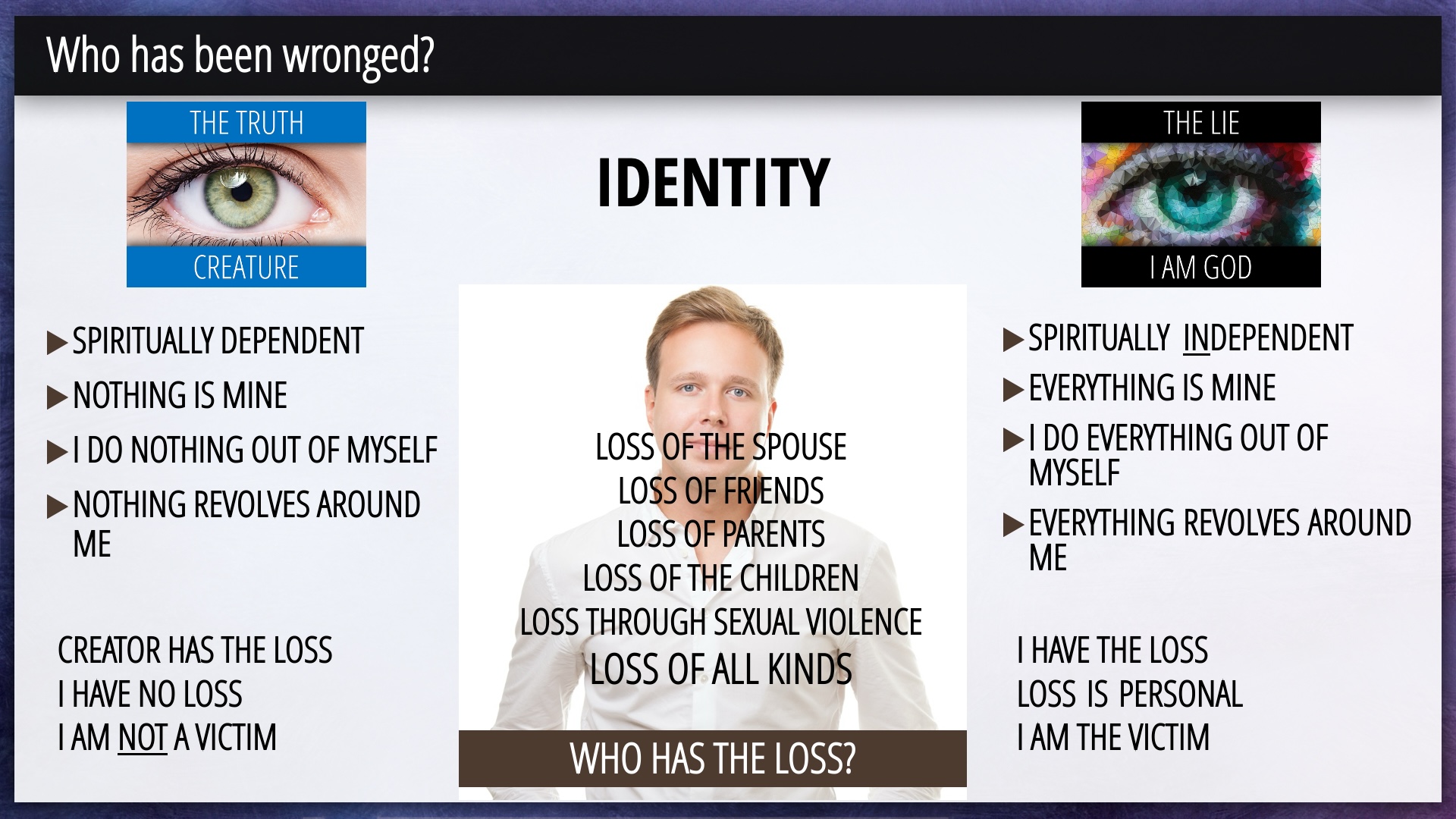
If someone is unable to process the injustice they have experienced from the perspective of a creature, they remain trapped in it for the rest of their lives and suffer illness and physical pain. I have spoken to some people who are still suffering after 40, 50 or 60 years, even all their lives, because something bad happened in their childhood. We don't have a choice. We have to evaluate everything we experience. We have to think it through and we cannot avoid, hide or omit this subsequent thinking. However, there is freedom of thought if I know from which perspective I am thinking. Anyone who adopts the perspective of the creature, which is the truth about ourselves, becomes free and, depending on the severity of the illness, healthy.