10. The Subconscious - Our Scales for Gain and Loss
When I recorded my patients' stories, I initially divided them into groups based on their complaints. I wanted to compare patients with the same complaints, such as tinnitus, dizziness, etc., because I assumed that different symptoms have different causes. I wanted to find a common denominator in each group. What do patients with tinnitus have in common? What do patients with vertigo have in common? Are there similarities and if so, what are they? I was most interested in the patients who had multiple illnesses and symptoms. What had happened in their lives that they had accumulated so many illnesses?
For years, I looked for similarities in the life stories of patients with similar symptoms. In 2007 I came across something that expanded my knowledge of people. No matter what story a person told me, as soon as it was negative (which all illness stories are), it always revolved around the idea of personal loss. I asked myself: "Is it possible that a single thought is the starting point for all problems and therefore for all human illnesses?"
It took a long time for me to become fully convinced of what triggers our illnesses. At some point, however, it became clear to me that it is personal loss alone that makes life difficult for us. It doesn't matter what story someone tells me, if it is negative, it is rooted in the idea of personal loss. I have not yet been able to find another principle. In my search, I came across the subconscious, which gave me the answers about the cause of human illnesses and problems.
In order to better understand the thought of loss, it is important to understand the subconscious, the functional center of the spirit. To show how people function via a central thought, I have put together a diagram. At the top is the level of the conscious spirit, below it is the subconscious spirit, which I also like to call the "heart". The conscious spirit contains the will. We perceive certain signals and information. In the diagram, the physical needs are marked in green: T for Thirst, S for Sweating, F for Freezing and H for Hunger. People must first become aware of these physical needs. Then they do something to satisfy them. The will is comparable to a screen on which "Action required!" lights up. You know there's a call to action.
The spiritual needs, shown in red, are also perceived. They are present in every person, but their order of priority is individual. Everyone has a main need on a spiritual level. In the illustration, I have placed H for Harmony in the middle because I myself need harmony. J stands for Justice, S for Security, W for Wisdom, F for Freedom and L for Loyalty. In order to satisfy these spiritual needs, you have to become aware of them, similar to your physical needs. All decisions made to fulfill a need are made in the subconscious. So, although I am aware of the needs, the decision is still made unconsciously.
The subconscious is the point of connection between the spirit and the body. As the spirit is always active in order to supply and control the body, it triggers an electrical impulse at the cerebral cortex every time a decision is made. It makes several hundred decisions within a second. This is why most decisions can be made only unconsciously.
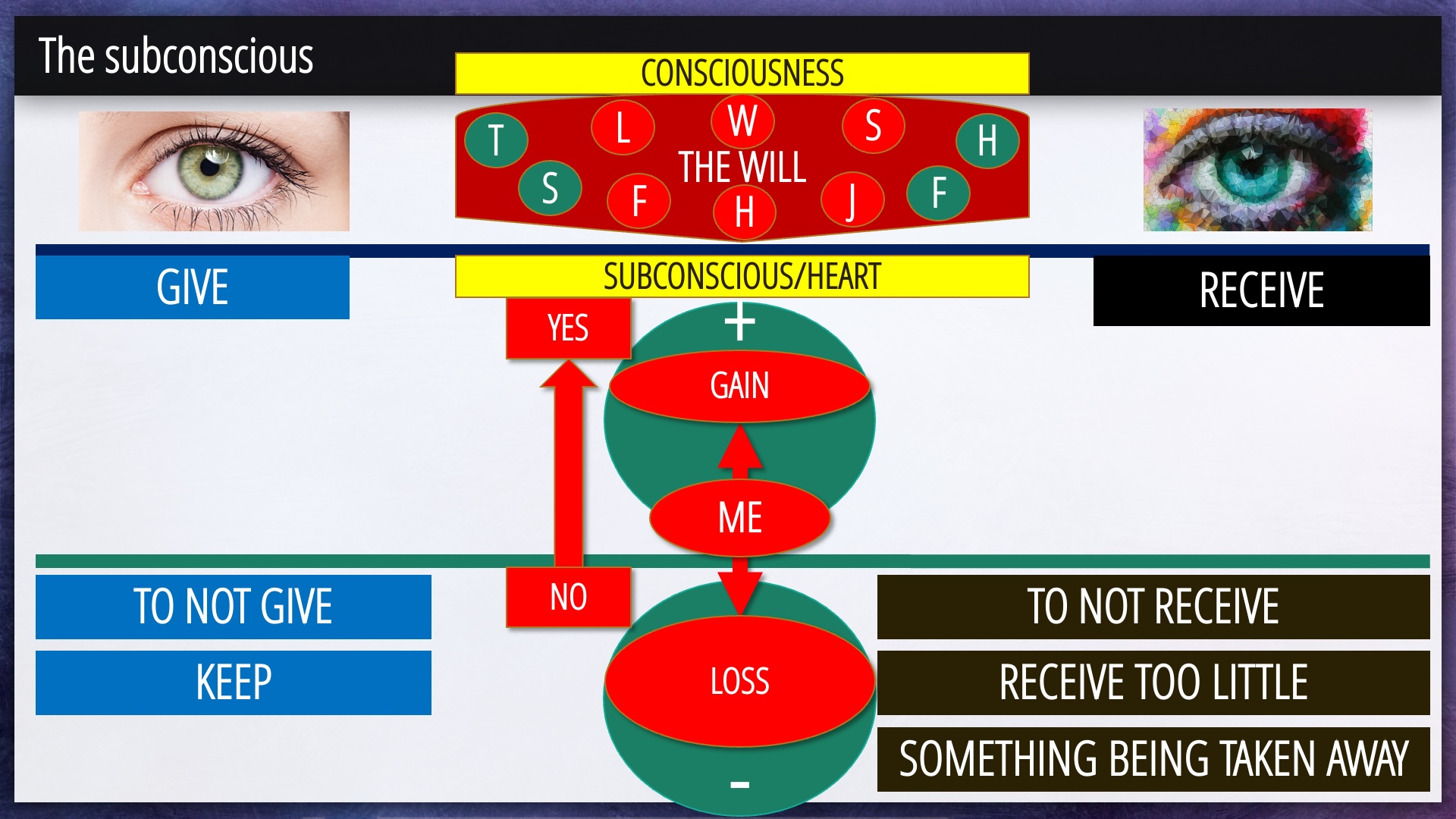
The spirit must evaluate all the information it receives at the entrance and can only sort it into two categories. These are labeled "gain" and "loss". Gain is that which meets the needs of the spirit and body. A loss is the opposite of this, i.e. an anti-need. There is also the zero line, i.e. information that meets neither a positive nor a negative need of the spirit and therefore does not trigger a reaction. The zero line is important because it determines the extent of the gain or loss. We make all of our decisions according to this simple categorization of gain and loss. Our decisions are predetermined with a "yes" to a gain and a "no" to a loss. There is no "yes" to a loss. Check yourself, e.g. why you donate to a good cause or why you don't. All human decisions can be traced back to a simple yes or no.
What must someone unconsciously think when they are hungry? They must see food as a benefit. Does this process happen consciously? No, it certainly does not. If someone has a selection of food in front of them, such as several pieces of fruit, then they unconsciously calculate the gain and loss for each of these fruits. Only then is the fruit selected and eaten.
There is no other decision-making level in people outside of yes and no. Every advertisement promises either profit or avoidance of loss. No one will respond to an advertisement that says: "Buy here, I have inferior goods and they are too expensive." There is no choice at this point. People must avoid everything that they see as a loss and say no to it. This process cannot be suspended or bypassed.
In the decision-making process of the spirit, he must avoid loss. If, and as long as he can do this, no fear arises. A person can press the brakes at a red traffic light and have no negative emotions. However, if they try to control circumstances, other people, time, money, etc, and it doesn't work then fear arises. So, we can also understand what fear is. Anxiety always arises when I think that I have to avoid something that is not under my control. There is only a fear of loss, never a fear of gain.
Illness and all of man's problems arise because he believes that he is losing his "no" (i.e. his ability to avoid loss). Humans are structurally determined to always say no to a loss and always yes to a gain. This is part of their function. Any loss or even the expectation of a loss or belief in it is not accepted. Personal loss cannot be accepted and makes the person who believes in it and experiences it broken and ill over time. This also depends on how great the loss is perceived by each individual. High personal loss leads to heavy emotions and, over time, to serious illness. Lower personal loss causes less strong emotions and illness. The level of personal loss is different for each individual. The same story of loss can be perceived and experienced with very different degrees of severity. The intensity is subjective and individual, but the mechanism by which decisions are made is identical for each person.
We calculate recorded impressions and information regarding winning and losing in a few thousandths of a second. For example, this was measured in the brain waves of players who had to make decisions.1 All information and perceptions are categorized into winning and losing. The mere fact that people believe they cannot avoid personal loss leads to all the problems that people face.
When I realized that all of man's problems arise from the belief that others can cause him personal loss, I looked for the cause of this idea. I found it in the spirit's perspective, which I represent with the two eyes. Before something is categorized as a gain or loss, there is a kind of filter: the point of view. This is what the two eyes in the upper corners of the illustration represent. The spirit has one (spiritual) eye through which it views everything. There are only two ways of looking at things and evaluating them accordingly.
With the eye on the right in the illustration, the spirit sees its gain in getting its needs met. If getting is regarded as gain, then loss must be the opposite of getting, i.e. not getting, not getting enough or getting something taken away. Conversely, with the eye on the left in the illustration, the spirit sees gain in giving. Then the opposite of this, i.e. not giving or keeping, is a loss.
At this point, we should remind ourselves of the Basic Law of Nature. There we examined the overarching principle of taking in order to give, which applies to all elements because everything functions according to the operation of a channel. Keeping does not correspond to this universal principle (the lungs do not keep oxygen, etc.). The law does not allow us to keep things that are taken in.
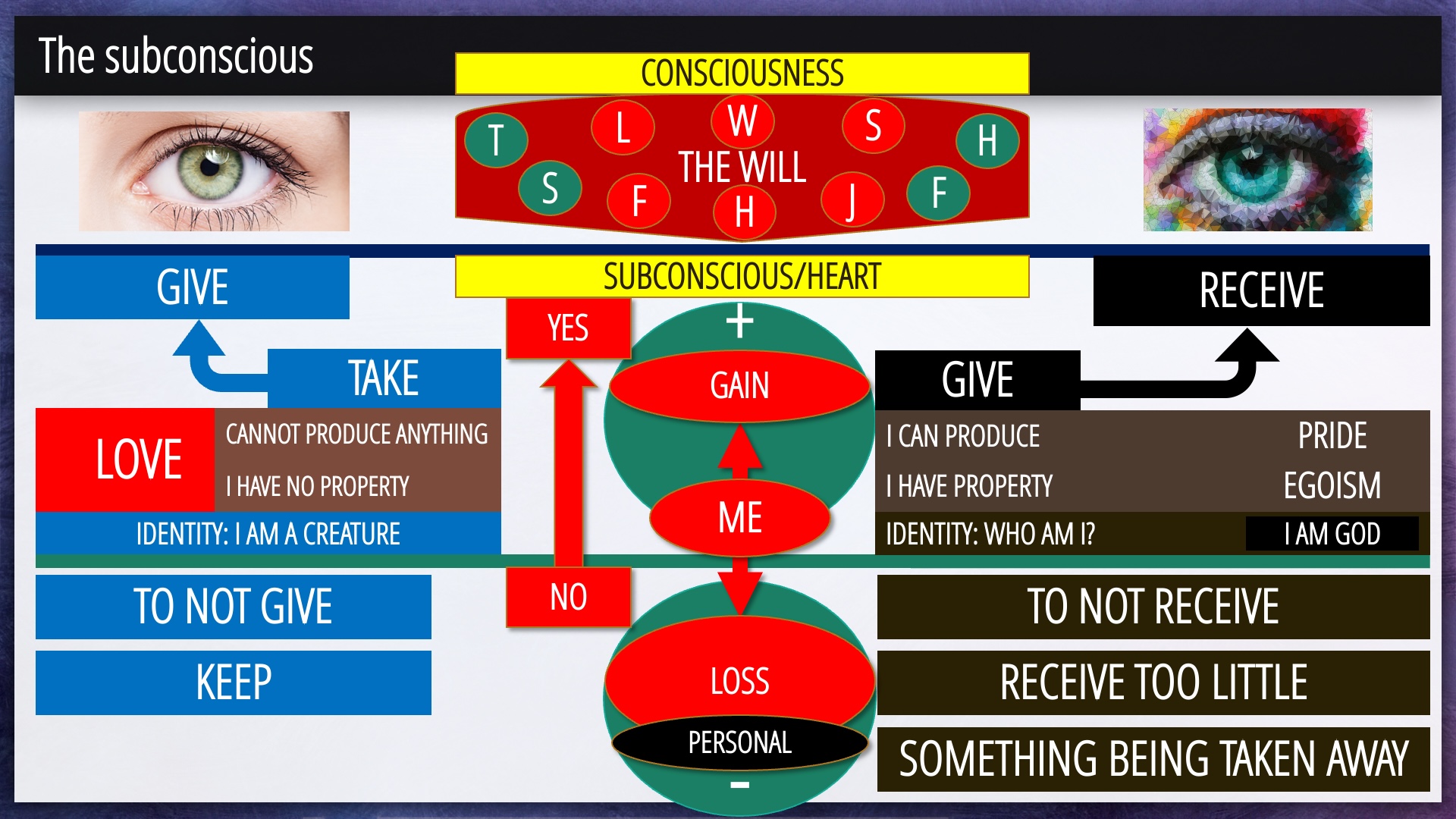
With which eye (i.e. perspective) do we see things as they are, and with which do we deceive ourselves? Which eye puts the "no" in the place where it cannot be taken away from the person (i.e. not giving/keeping as loss)? In the illustration on the previous page, the eye on the left provides people with the ability to always implement their "no" under any circumstances. Gain and loss there lie solely in the actions that I do or refrain from doing. Taking, giving and keeping are always my own actions.
But the eye on the right creates a deceptive view. This eye suggests that gain depends on getting and loss results from not getting. This means that the eye always looks at what others are supposedly doing right or wrong and at what they are not doing. The focus is not on your own actions, but on the actions of others. With this view, you make yourself completely dependent on other people to satisfy your own spiritual needs.
It is both fascinating and frightening to see every one of us is constantly preoccupied with the other in order to satisfy our own spiritual needs. Who do the spouses talk about almost exclusively when they come for counseling? The focus is completely on the other person. They always talk about their partner's wrong behavior.
A situation in which someone wants to control another person arises only from the intention to ensure that the other person does not cause them any loss. This gives rise to all control and surveillance mechanisms.
There are only these two ways of looking at things:
- A person is in control of his own decision regarding yes and no. Since no one else can think for him, it is obvious that "yes" and "no" belong to him.
- Others can cause a person a loss that he cannot avoid. As long as a person is in gain and gets what meets his needs, he still feels comfortable and has no problem. However as in Case 8, if after 35 years, the spouse's cheating comes to light and the previous gain suddenly turns out to be a "not getting" or "being taken away", this becomes a burden for the rest of her life. This is because the prevailing thought is that the other person has caused me a loss.
There is a tip of the scales in this system. The decisive factor is whether the person thinks it is a personal loss. If a negative event happens outside of our personal relationships, such as the death of a child or abuse, then it is certainly a loss, an injustice, a bad thing. The decisive factor as to whether or not this has a lasting effect on the person's spirit is whether it is assessed as a personal or impersonal loss. If, in Case 5, the young woman with the headaches is angry about her unfaithful boyfriend, then she undoubtedly takes his actions personally. She thinks: "He did it to me." However, if she thought that the boyfriend had not done it to her personally, then her problem would be solved.
Yes, the boyfriend has certainly done something wrong, but did he really do anything to her personally? Did the woman really have a binding claim to his fidelity? Where does this claim to others come from?
In my search for an answer, I came across the deepest part of the human spirit - its identity. What does man think about who he is?
-
Fehr, T., Herrmann, M., Meyer, G., Miedl, S., (2010). Neurobiological correlates of problem gambling in a quasi-realistic blackjack scenario as revealed by MRI. Psychiatry Research: Neuroimaging. 181, 165-173 ↩