6. The Soul - The Sum of Body and Spirit
According to evolution-based science, the spirit originates from matter. However, it is not called a spirit, but the "psyche". The psyche is seen as the result of the activity of the cerebral cortex. If this were the case, then physical needs and hardships should be more important than spiritual ones. The body should control the spirit. We have seen that this is not the case.
According to natural law, no immaterial spirit can emerge from the chemistry or matter of cells. Just imagine the body creating a psyche, that then decides to give the body something to eat or not, or that makes it jump from the 11th floor, etc. That would be implausible according to reason and contrary to the law of cause and effect.
It is the spirit that triggers a flow of electricity into the body by means of thoughts. Depending on the direction of these thoughts, the current in the body can cause malfunction, self-harm and even illness.
This shows that the electrical impulse generated by the spirit must have a fixed effect on the cerebral cortex, i.e. the "right" thoughts lead to an impulse that is appropriate for the body, while the "wrong" thoughts have a harmful effect. The cerebral cortex is matter and makes no decision of its own accord and has no degree of freedom as to how it reacts to the spirit or the thought. This means that the right way of thinking of the spirit, which gives the body the right electrical impulse, can be reliably read in the body. At the same time, the wrong, non-body-appropriate electrical impulse in the body also gives an objective reaction. An objective measurement for subjective thinking is a very beneficial thing, especially when it comes to our lives and our health.
But before we find out these details, we should get an overview of anthropology, i.e. the theories of human nature. There are many different theories about the structure of human beings, but we will consider only the three best-known approaches here.
- On the one hand, the human being is seen as an interplay of three independent entities: body, spirit and soul. The soul and spirit are spiritual entities. This view of the human being was shaped by the ancient Greeks and is therefore referred to as the Platonic and Aristotelian view of the human being. Plato describes man very vividly as a god trapped in an animal body. Consequently, death is a kind of liberation for man. He then becomes a god again.1 This understanding of the human being is still influential today and can be found in many religions, especially Christianity.
- There has also been an alternative concept since the ancient Greeks; the Stoic and Epicurean view of man. According to this view, the entire human being is exclusively chemistry and spiritual abilities also arise from this. The majority of evolution-based medicine and science still adheres to this rather simple view of humanity today. According to this view, love or passion arises through "combustion" in the cells.
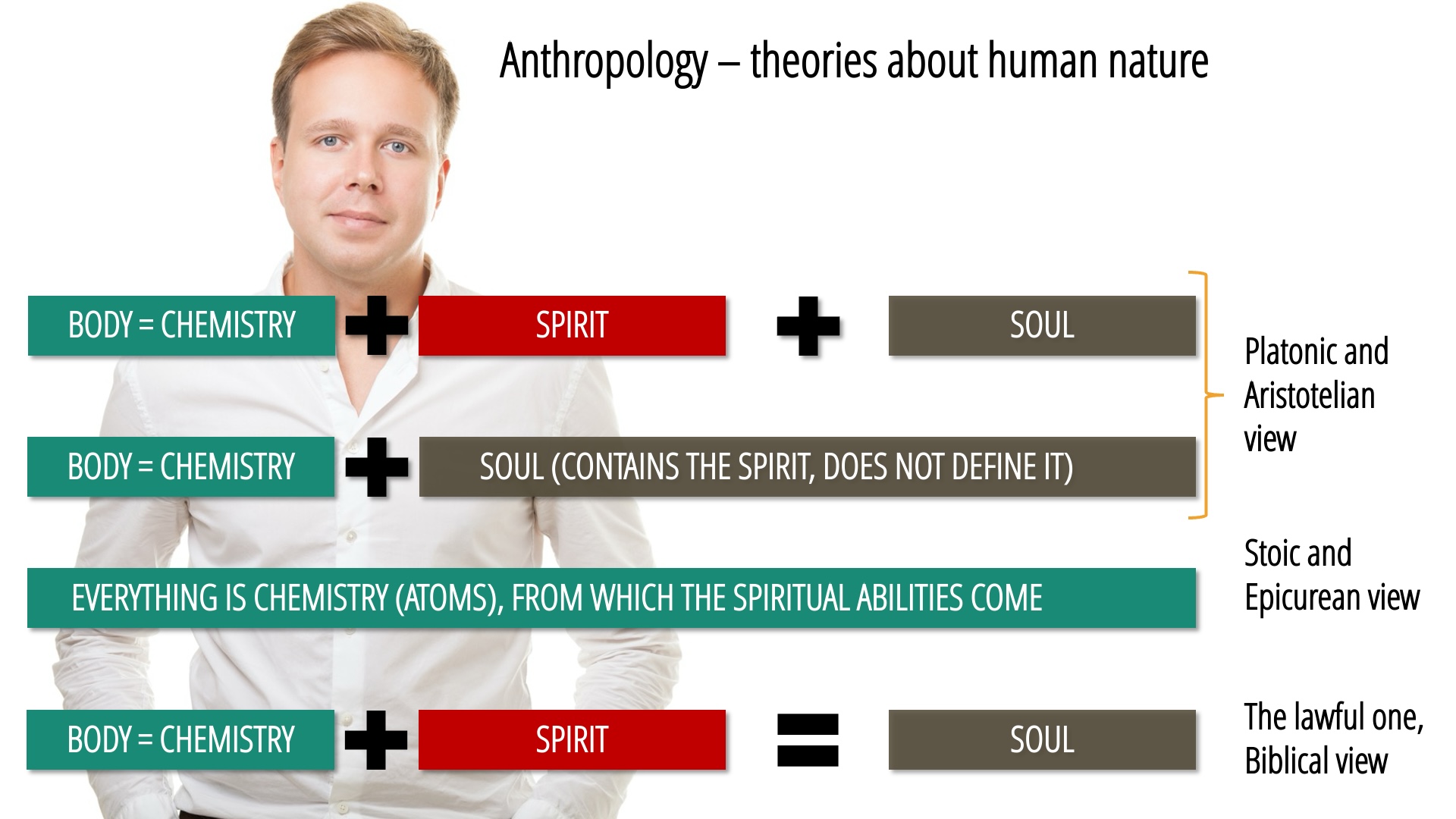
- In light of what has been said so far, there is irrefutable evidence that matter alone cannot explain the human being. According to the Basic Law of Nature, it is necessary for the body to be controlled by a force that it cannot make available to itself. It is therefore plausible to see the human being as consisting of two units: body and spirit. I could not find a third unit, that is often referred to as the soul. However, on the basis of the interdependence of body and spirit (one cannot do anything without the other), the word "soul" is a good term for the whole living being. The human being is therefore a soul, consisting of body and spirit.
A comparison to illustrate this is water. Water (H2O) is present when we have oxygen and hydrogen together. Just as water consists of two elements, the soul also consists of two inseparable elements. If the elements of H2O are separated, we no longer have water, but hydrogen and oxygen. If spirit and body are separated, the human being is dead. This means that the soul no longer exists, but only the separated elements, spirit and body. The human being can only function if both entities are together.
Another illustration for the cooperation between spirit and body is the connection between a piano player (equivalent of the spirit) and a piano (equivalent of the body). The piano cannot produce sounds on its own, nor can the player produce piano music without the piano. Music is created when the player and piano work together. This music (equivalent of the soul) is the interaction of a player and an instrument. In the same way, the soul is the result of the interaction of spirit and body. Two different components result in a new entity, the living soul. According to the law, there are mutual dependencies, but the body is controlled by the spirit. If there is a separation, there is no more music. Likewise, life ends when the spirit leaves the body.
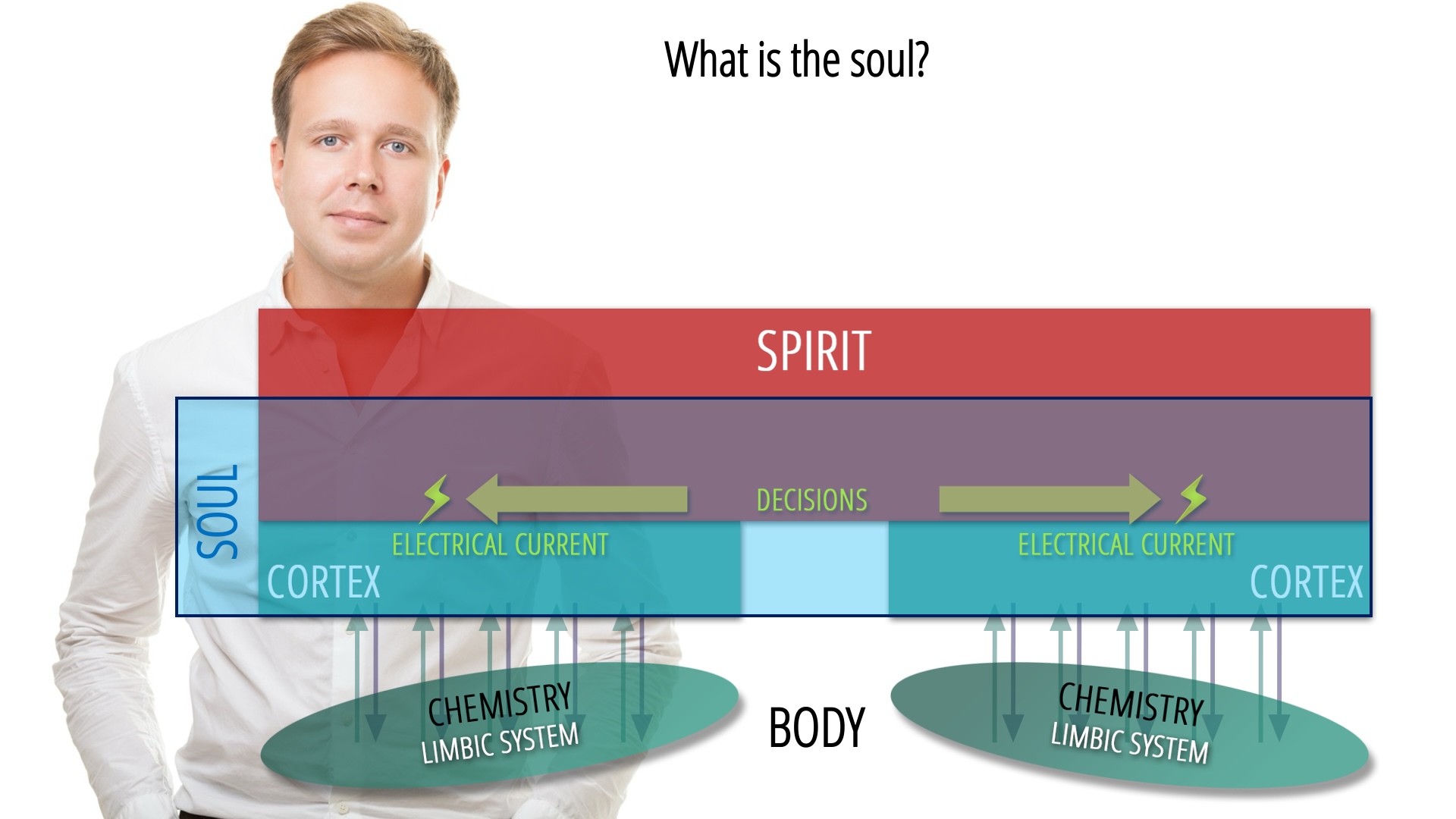
The spirit and body therefore form a functional unit. Both can function only together. Nevertheless, the spirit is primary and controls the body. For its part, the body has fixed settings that the spirit cannot override. This means that even if the spirit controls the body, it cannot do more with the body than what the body is able. This is why the human spirit is limited and restricted by the body.
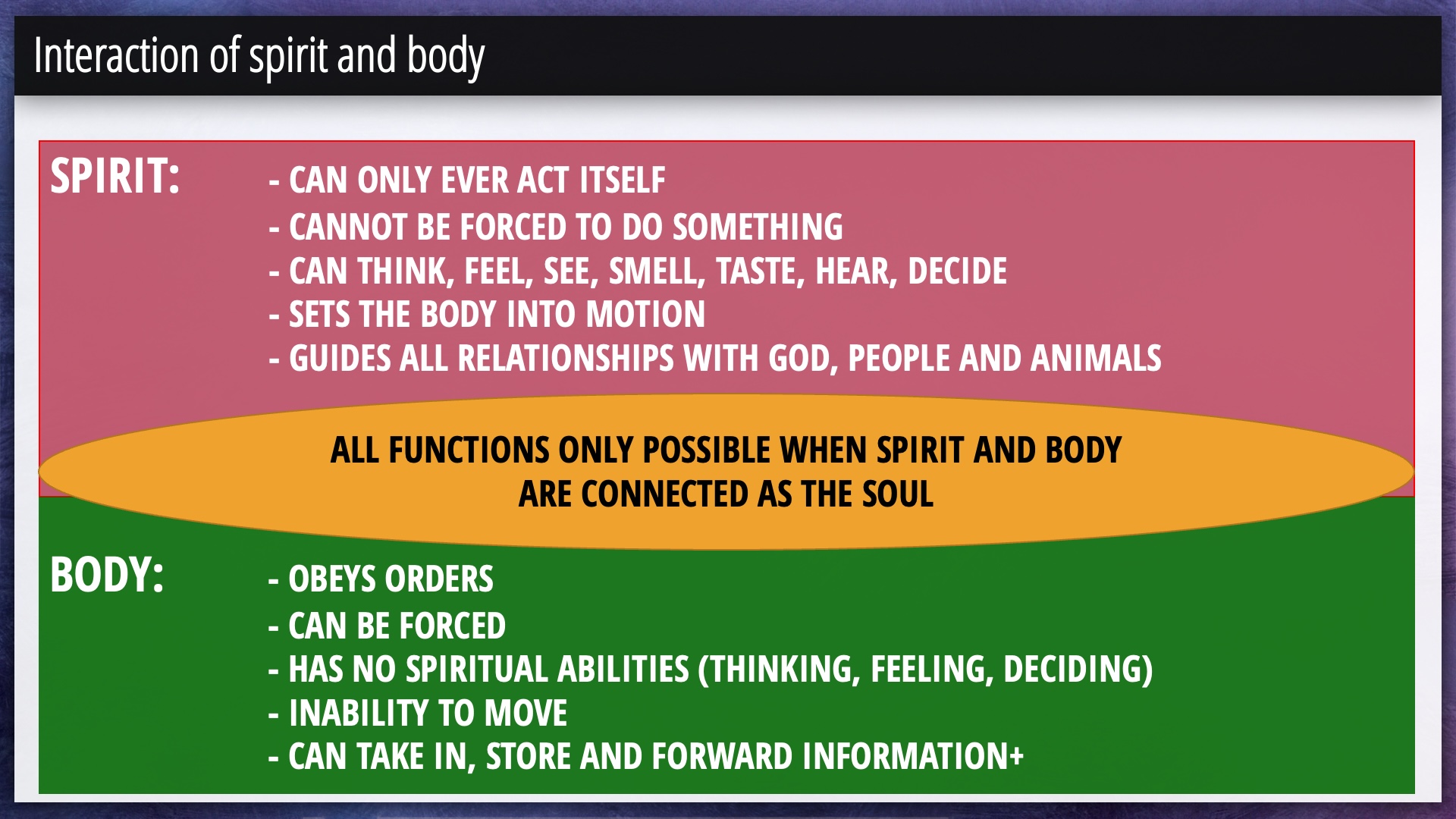
This makes it clear that the five human senses - hearing, sight, smell, taste, touch - can exist only in combination with the body and the spirit. The physical information reaches the cerebral cortex via the nerves through the body and is then presented to the spirit, which hears, sees, smells, tastes or touches it. The spirit's ability to think is also dependent on the cerebral cortex. The spirit thinks for itself, but not without the cerebral cortex. Just as the feet are used to walk, even though they cannot walk on their own, the spirit cannot think without a functioning brain. Both are always involved in everything a person does.
-
Reuter, H. (2014): History of Psychology. Hogrefe, pp. 31-45 ↩